

Should I Get Radon Testing When Buying a Home in Bentonville AR?
For most Bentonville buyers, yes — and October through the winter is the best stretch of the year to do it, because the test is more reliable when the house is closed up.
Radon is the one common home hazard that gives you no warning at all. It has no smell, no taste and no color. You cannot see it in a walkthrough, an inspector cannot spot it visually, and a house can look immaculate and still have a level worth acting on. The only way to know is to measure.
Here is what that means for a home purchase in Bentonville, why the season matters, and how the test fits alongside your home inspection.
What Is Radon and Why Does It Matter in Northwest Arkansas?
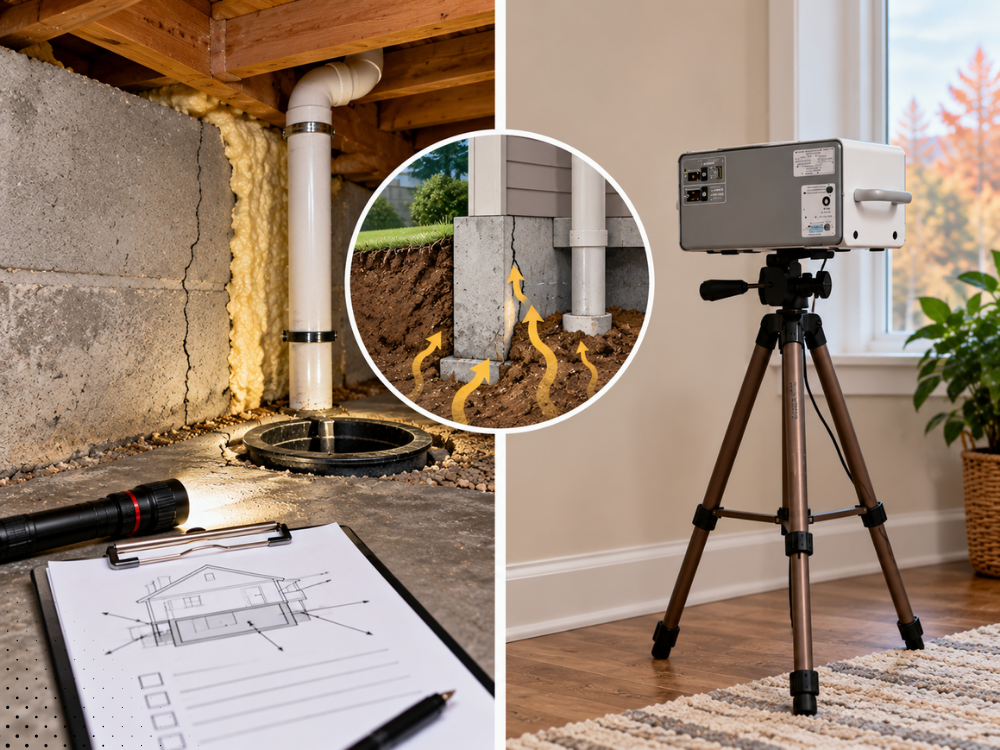
Radon is a naturally occurring radioactive gas produced as uranium in soil and rock breaks down. It moves up through the ground and enters a building through whatever openings exist — foundation cracks, slab penetrations, sump pits, crawl space floors, and gaps around plumbing and conduit. Once inside, it can accumulate.
The U.S. Environmental Protection Agency identifies radon as a leading cause of lung cancer, and recommends action at 4.0 picocuries per liter (pCi/L) or above, while noting that risk exists below that level too.
The reason it matters here specifically is geology. Northwest Arkansas sits on the southern edge of the Ozark Plateau — limestone, dolomite and shale, exactly the kind of rock associated with radon production. That does not mean every Bentonville home has elevated radon. It means the potential is real, and it varies enormously house to house. Two homes on the same street can test very differently, because the result depends on your specific soil, your foundation type and how your house exchanges air.
That is the single most important thing to understand: your neighbor's result tells you nothing about your house. There is no way to reason your way to an answer. You test.
Why Is Fall and Winter the Better Time to Test?
Because radon measurement depends on closed-house conditions, and from October onward that is simply how people live.
A short-term radon test requires the house to be closed up — windows and exterior doors shut except for normal entry and exit — for at least 12 hours before the test and throughout the measurement period. In an Arkansas July, with doors opening constantly, that is an artificial condition. In late October, with the heat starting to run, it is just an ordinary week.
There is a second effect. As heating season begins, warm air rising inside the house creates a mild negative pressure at the lowest level, which tends to draw soil gas in. The result is that heating-season readings often reflect the higher end of a home's real annual range — which is exactly what you want to know before you buy, rather than the most flattering possible number.
So a test run now tells you more than the same test run in June.
How Does Radon Testing Fit With the Home Inspection?
It is a separate service with its own scope, ordered alongside the inspection.
A home inspection is a visual and operational evaluation of the accessible systems of the house. An inspector can identify the pathways radon uses — foundation cracks, an open sump pit, an unsealed crawl space, gaps at slab penetrations — but no visual inspection can tell you the concentration. That requires a measurement device left in place for a defined period.
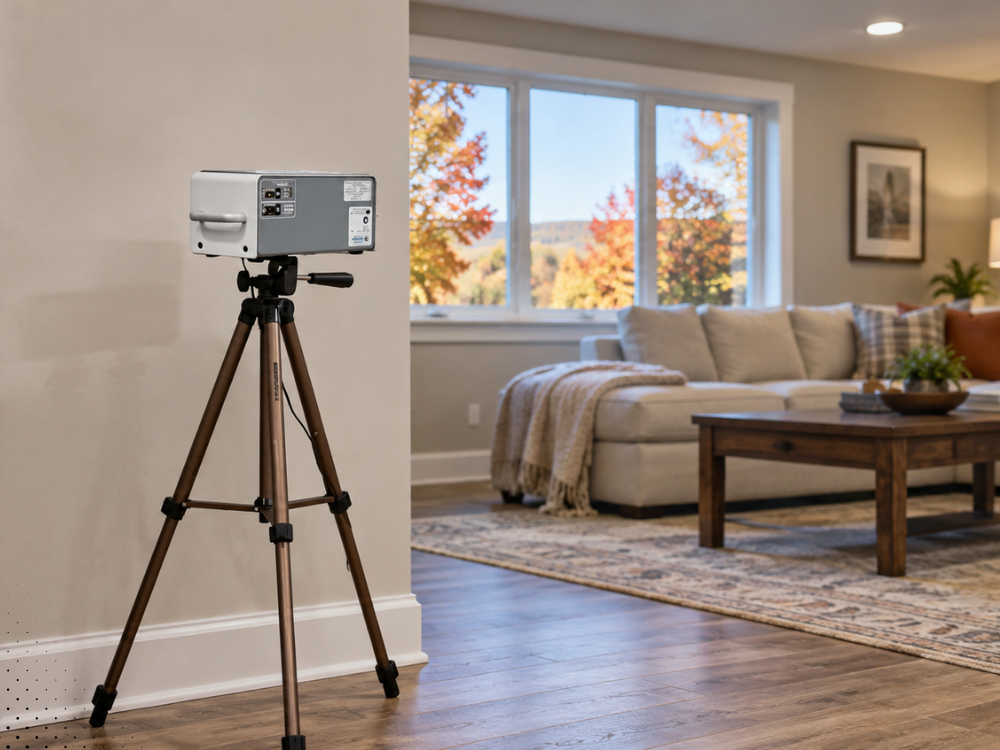
Practically, the two are scheduled together. The test device is placed at the time of the inspection, in the lowest livable level of the home, away from drafts, exterior walls and vents, and left undisturbed for the measurement period. The result comes back as a number you can act on inside the inspection contingency period.
Timing matters here. Radon testing takes days, not hours. Ordering it on day one of your inspection period gives you room to act on the result. Ordering it on day seven does not.
Buyers can also learn more about Detect-It’s Buyer’s Home Inspection service before scheduling an inspection.
What Do You Do If the Result Is High?
This is where buyers tend to panic unnecessarily. A high radon result is one of the more solvable problems a home inspection period can surface.
Radon mitigation is a well-established process. The standard approach for most homes is sub-slab depressurization — a pipe run from beneath the slab up and out above the roofline, with an inline fan that vents soil gas outside before it can enter. It is a straightforward installation, generally completed in a day, and it is highly effective. Post-mitigation testing confirms the reduction.
For a buyer, this makes radon a negotiable, quantifiable item rather than an open-ended fear. You have a number, there is a known fix, and a mitigation contractor can quote it. That is a far better position than discovering the issue after closing.
It is worth adding that a home already carrying a mitigation system is not a red flag — it is a house where somebody tested and dealt with it. What matters is whether the system is operating and whether a post-mitigation test confirms it is working.
What Else Should Bentonville Buyers Be Looking At This Fall?
Radon is one item on a fall inspection list shaped by Northwest Arkansas terrain and weather.
Drainage and grading on sloped lots. Bentonville is Ozark terrain. Water moving downhill toward a foundation is the single most common driver of moisture findings here — look for erosion channels, downspouts discharging at the wall, and grade falling toward the house.
Crawl space condition. Standing water, displaced vapor barrier, fallen insulation, elevated framing moisture. It is also a radon entry point, which is why the two conversations overlap.
Roof and valleys under tree canopy. Wet leaf litter held in valleys shortens roof life, and limbs resting on shingles abrade granules.
The heating system, before the first cold morning. It has sat idle since spring. Age, heat exchanger condition and combustion venting all matter — and combustion appliances make working carbon monoxide alarms non-negotiable.
Trees over the roof and the service drop. Benton County gets ice reliably, and ice is a tree-and-power problem before it is anything else.
Plumbing in unheated space — crawl spaces, garages and exterior walls are where lines split.
Buyers purchasing a newly built property can also review Detect-It’s New Construction Inspections for Bentonville and Northwest Arkansas homes.
Q&A: What Bentonville Buyers Ask About Radon
Do all homes in Bentonville AR have radon?
All homes have some radon, because it occurs naturally in soil everywhere. The question is concentration, and that varies dramatically from house to house depending on the specific soil, foundation type and air exchange. Northwest Arkansas geology gives the region real potential, which is why testing rather than assuming is the right approach.
Can the home inspector tell me if a house has radon just by looking?
No. Radon has no smell, color or taste, and no visual inspection can determine concentration. An inspector can identify the entry pathways — foundation cracks, sump pits, unsealed crawl spaces, slab penetrations — but the level requires an actual measurement.
Is radon testing worth it on a newly built Bentonville home?
Yes. New construction is not inherently lower. A new home is tightly sealed, which reduces air exchange, and soil gas still enters through slab penetrations and foundation joints. Some newer homes are built with passive radon-resistant features, which help but do not guarantee a low result without testing.
How long does a radon test take?
A short-term test typically runs two to seven days under closed-house conditions, with a 12-hour closed period beforehand. Order it early in your inspection contingency period so the result arrives while you still have room to negotiate.
What is the EPA action level?
The EPA recommends action at 4.0 pCi/L or higher, and notes that risk is reduced further by lowering levels below that. Your inspector will report the measured result against that benchmark.
Should a seller test before listing?
Many Bentonville sellers do. Testing before listing means you learn the number on your own timeline, and if mitigation is warranted you can have it installed and verified rather than negotiating it under a deadline with a nervous buyer.
Sellers preparing before listing can learn more about Detect-It’s Pre-Listing (Seller) Inspections.
Does a house with a mitigation system already installed have a problem?
It has a solved problem. Somebody tested and acted. What matters is that the system is running and that a post-mitigation test confirms the level is where it should be — both worth confirming during your inspection.
Schedule Radon Testing With Your Bentonville Home Inspection
Radon is invisible, common enough in Northwest Arkansas to take seriously, and one of the few home hazards with a clean, well-understood fix. The only mistake is assuming.
If you are buying a home in Bentonville, Rogers, Bella Vista, Centerton, Lowell, Fayetteville, or the surrounding Northwest Arkansas area, schedule your home inspection with radon testing early in your inspection period so the result arrives in time to use.
Call Brian at 479-551-8040 or book your Bentonville home inspection online.
